

You're in the kitchen, the water's boiling, the cup is waiting – but how much coffee grounds do you actually need? Don't worry, you don't have to calibrate a precision scale. While we at Günter Coffee swear by fine-tuning the perfect taste down to a tenth of a gram, in everyday life, in a shared kitchen, or at a friend's house, a simple measurement often has to suffice.
We've compactly summarized the coffee quantities for the most common brewing methods.
The Spoon Multiplication Table
Before we get to the methods, here's your most important guide if you're working without a scale:
- 1 heaped teaspoon: approx. 3 to 4 grams of coffee grounds
- 1 level coffee scoop: approx. 7 grams of coffee grounds
- 1 heaped tablespoon: approx. 7 to 9 grams of coffee grounds
Note: In the examples, we always assume a nice, large cup or mug (approx. 250 ml of water), except for espresso.
Coffee Quantity by Preparation Method
Simply click on your preparation method to get the correct dosage:
Which preparation method do you need the amount of coffee grounds for?
- I currently have an espresso maker/stovetop moka pot here
- I'm standing in front of a filter coffee machine or a pour-over filter
- I'm brewing with a French press
- I'm holding a portafilter in my hand
- I'm brewing with a Cezve/Ibrik
1. Espresso Maker (Stovetop Moka Pot / Bialetti)
Probably the most relaxed method, because you don't have to count at all!
- The spoon rule: None at all! Simply fill the filter basket of your moka pot loosely to the brim with coffee grounds. Level it out, but do not press it down firmly. The moka pot itself dictates the quantity based on its size.
- Deeper into the topic: You can find more tips for creamy results in our guide Brewing Coffee with an Espresso Maker.
2. Filter Coffee Machine and Pour-Over Filter
The undisputed classic in our kitchens.
- The spoon rule: Use 2 heaped tablespoons for a large mug (250 ml). If you're brewing a whole liter in the machine, you'll need about 7 to 8 heaped tablespoons.
- In grams: The golden rule for filter coffee is about 60 grams per liter of water (i.e., approx. 15 grams per mug).
- Deeper into the topic: Get the best out of your pour-over filter with our Pour-Over Brew Guide. For filter coffee machines, you can refer to the Brewing Instructions for the Moccamaster.

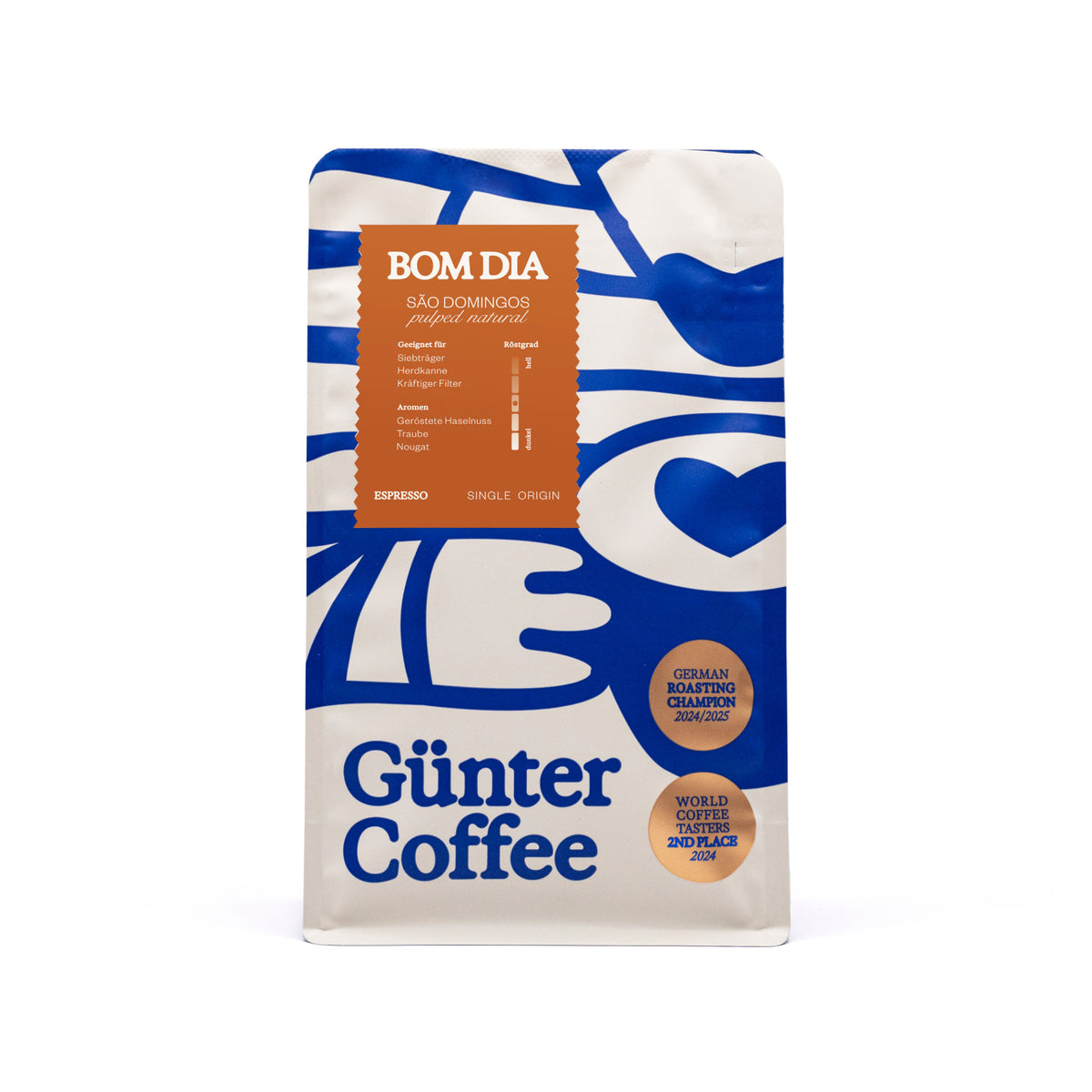
We taste Grape, Nougat und Roasted Hazelnut. What do you taste?
Try our BOM DIA Espresso.


3. French Press
Since the coffee is fully immersed in water here (Full Immersion), it often benefits from a little bit more.
- The spoon rule: Use 2 to 3 heaped tablespoons for a large mug (250 ml), depending on whether you prefer a gentle or very strong body.
- In grams: Calculate with about 65 grams of coffee grounds per liter of water (approx. 16 to 17 grams per mug).
- Deeper into the topic: This is how to make perfect French press coffee: Brewing Coffee with a French Press.
4. Portafilter Machine (Espresso)
This is where it gets tricky, because with espresso there is no standard cup and high pressure builds up. Spoon measurements unfortunately don't work well here.
- In grams: For a classic "Doppio" (double espresso), fill 16 to 18 grams of very finely ground coffee into the portafilter. From this, you should extract approximately 32 to 45 grams of liquid espresso in about 25 to 30 seconds (brew ratio 1:2 to 1:2.5).
- Deeper into the topic: In our Espresso Brew Guide, we explain how to pull the perfect shot.
5. Traditional Moka (Cezve / Ibrik)
The oldest coffee preparation method requires the finest powder – almost like powdered sugar.
- The spoon rule: Use 2 heaped teaspoons for a small Moka cup (70 ml water).
- In grams: The standard ratio is 1 part coffee to 10 parts water (e.g., 7 grams of coffee to 70 ml of water).
- Deeper into the topic: The fascination behind the sand and copper pot can be found here: The Oldest Coffee Preparation Method.
Pro-Tip: Why a Scale Is Still Worthwhile in the Long Run
You now have your quick answers and can start brewing right away. However, if you want to explore the diversity of specialty coffee flavors even more intensely, you'll eventually need a small scale.
The reason is simple: Coffee beans, depending on the variety and roast, have different volumes. A light-roasted bean from Ethiopia will weigh more than a dark roast from Brazil for the same visual amount on a spoon. Since we deliberately avoid strongly dominant, classic roast aromas in our roasts and prefer to celebrate coffee as a fruit, a scale helps you enormously to reliably bring those sweet or fruity nuances into your cup.
It has to taste good to you
Whether meticulously weighed or casually spooned – the most important thing is that your coffee tastes good to you and that you enjoy experimenting. We want to encourage you to do just that: Discover how different coffee can taste!
How do you do it at home? Are you more of a "by eye" person in the early morning, or do you reach for the scale for every cup?